Electro-Oxidation (EO) System
- Electro-Oxidation (EO)
Electro-Oxidation (EO) Systems
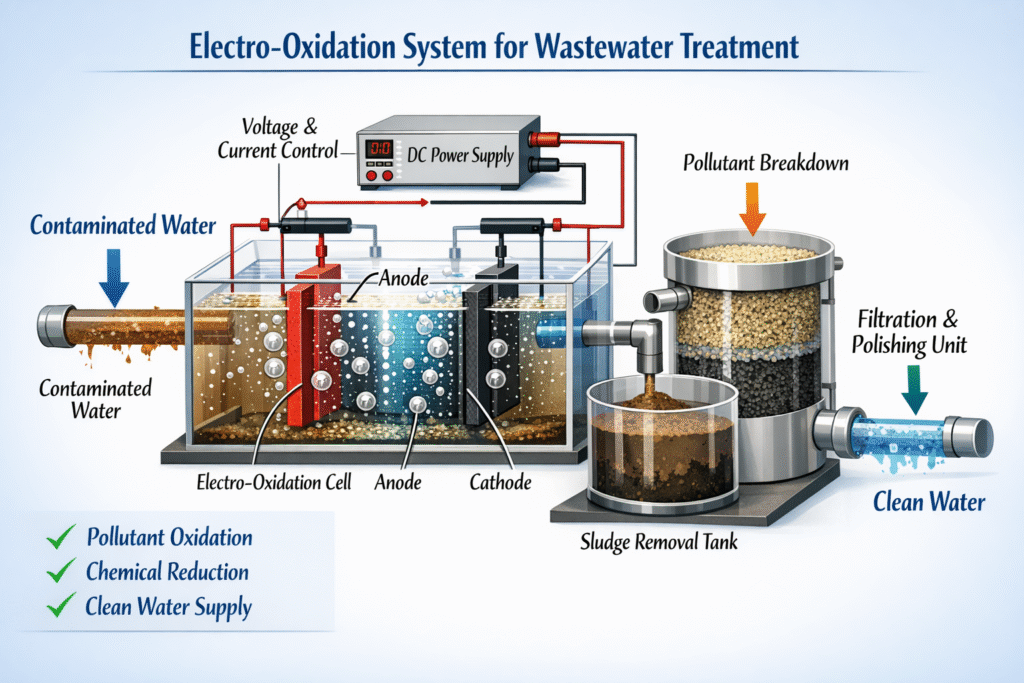
Electro-Oxidation (EO) systems are advanced electrochemical treatment technologies developed for the degradation of dissolved organic pollutants, refractory compounds, and trace contaminants that are resistant to conventional treatment methods.
The process relies on the generation of powerful oxidizing agents directly within the wastewater matrix through controlled electrical reactions at electrode surfaces.
EO systems are particularly effective in addressing wastewater streams containing persistent organics, color bodies, pharmaceuticals, phenols, and other compounds that exhibit low biodegradability.
Treatment Objective and Scope
The central objective of electro-oxidation is molecular degradation rather than physical separation. Unlike coagulation-based processes, EO targets dissolved contaminants at the chemical level, breaking complex molecules into simpler, less harmful constituents or fully mineralizing them into carbon dioxide and water. This function positions EO as a tertiary or advanced treatment step, commonly applied where discharge standards require high effluent purity or where water reuse is a strategic objective.
Electrochemical Reaction Environment
EO systems utilize specialized anodes engineered to withstand high oxidative potential while maintaining long operational life. These electrodes facilitate the formation of oxidizing species such as hydroxyl radicals and active chlorine compounds, depending on wastewater composition.
The reaction environment is carefully controlled to ensure consistent oxidation performance without generating secondary contamination or excessive by-products.
System Architecture and Control
An EO system comprises electrochemical reactors, power regulation units, hydraulic control components, and monitoring instrumentation. System parameters such as current density, electrode surface area, and hydraulic retention time are optimized during design to match specific wastewater profiles.
Advanced control logic allows EO systems to operate under dynamic influent conditions, maintaining treatment efficiency even during peak contaminant loading.
Residual Management and Process Cleanliness
Electro-oxidation produces minimal residual sludge compared to chemical oxidation processes. The absence of chemical dosing reduces secondary waste generation and simplifies downstream solid handling requirements.
This cleanliness of operation is a key factor in facilities where space, disposal capacity, or regulatory restrictions limit sludge management options.
Compatibility with Advanced Treatment Systems
EO systems are frequently integrated with membrane technologies, biological treatment units, and polishing processes. When positioned upstream of membrane filtration, EO reduces organic fouling potential and enhances membrane lifespan. When applied downstream, it ensures compliance with stringent discharge or reuse standards.
The flexibility of EO allows it to be configured as either a standalone advanced treatment unit or as part of a multi-barrier treatment strategy.
Environmental and Regulatory Alignment
Electro-oxidation supports environmental protection objectives by reducing the release of toxic and persistent compounds into receiving environments. Its ability to degrade contaminants at the molecular level aligns with increasingly strict wastewater regulations across industrial and municipal sectors.
The technology contributes to long-term sustainability goals by enabling higher levels of water recovery and safer effluent discharge.
Role in Future-Ready Treatment Systems
As wastewater regulations evolve and contaminant profiles become more complex, EO systems provide a forward-looking solution capable of addressing emerging pollutants. Their adaptability and high oxidation potential position them as a critical technology for advanced wastewater treatment frameworks in the Middle East.
Contaminant Degradation Scope and Treatment Depth
Electro-Oxidation systems are designed to address contaminants that persist beyond conventional treatment boundaries. The oxidation mechanisms target molecular structures rather than physical phases, allowing EO to reduce compounds that resist biological degradation or physical separation.
Core treatment characteristics include:
Breakdown of refractory organic compounds
Reduction of residual toxicity
Oxidation of color-causing molecules
Decomposition of trace contaminants
Enhanced effluent stability
The depth of treatment achieved through EO supports stringent discharge requirements and high-quality reuse objectives. By addressing contaminants at a chemical level, EO systems provide a final assurance stage within advanced treatment trains.
Why Choose RTW for Electro-Oxidation (EO) Systems
RTW designs electro-oxidation systems with a focus on oxidation efficiency, process control, and long-term adaptability. Each EO system is configured based on influent chemistry, oxidation demand, and required effluent quality, ensuring precise contaminant degradation without secondary process instability.
Precision Oxidation Engineering
RTW configures electro-oxidation systems based on oxidation demand and target contaminant profiles. Reactor design and electrode selection are optimized to achieve controlled degradation of refractory organics without generating unstable by-products.
Advanced Electrical and Process Control
EO systems are equipped with regulated power control and monitoring frameworks that maintain consistent oxidation intensity. This ensures predictable treatment outcomes even under fluctuating influent composition and loading rates.
System Compatibility and Expandability
RTW EO units are designed to integrate smoothly with membrane systems, polishing stages, and reuse treatment chains. Modular configurations allow capacity expansion or process upgrades without structural redesign.
Regulatory and Environmental Alignment
Each EO system is engineered to support compliance with evolving discharge and reuse standards. RTW’s design methodology emphasizes consistent effluent quality, reduced residual formation, and long-term environmental protection.
Contact RTW to discuss Electro-Oxidation (EO) Systems engineered for industrial reliability, treatment consistency, and long-term wastewater management performance.